

When deciding what to buy, packaging and price are two of the biggest factors that influence your choice. For new products like Cultivated Meat, these elements are especially important. Here's the key takeaway:
- Packaging: Shapes first impressions with design, colours, and labels. It can highlight benefits like animal welfare or health, helping build trust for unfamiliar products.
- Price: Signals quality and affordability. Higher prices suggest premium quality, while lower prices make products more accessible but may raise doubts about safety or value.
Both factors need to work together. For example, premium packaging paired with mid-range pricing (£15–£20 per kg) often creates the best balance, building trust and encouraging purchases. If either element feels mismatched, it can lead to hesitation or confusion.
Key insight: Packaging tells the story, while price determines whether people feel comfortable buying. Together, they shape how you perceive value and quality in products like Cultivated Meat.
Packaging and Pricing: The Key Revenue Strategy Most CEOs Miss
sbb-itb-c323ed3
How Packaging Affects Consumer Choices
Packaging plays a pivotal role in shaping consumer expectations even before they experience a product. For a new category like Cultivated Meat, where 64% of consumers admit they are completely unfamiliar with it [3], the design of the packaging becomes a key tool in building trust. Every detail matters when it comes to easing doubts and creating a sense of reliability around this emerging product.
Visual Design and First Impressions
Colour is one of the most influential elements in packaging design - arguably more impactful than the shape of the packaging itself [2]. Darker shades suggest qualities like richness, durability, and substance, while lighter tones are often associated with convenience and lightness [2]. These visual signals shape consumer expectations about taste and quality long before they’ve even tried the product.
"Product packaging serves as a powerful multisensory cue that shapes consumer expectations, emotional responses, and purchasing behaviour–often before the product is even consumed." – Scientific Reports [2]
The shape of the packaging also sends subtle messages. Angular designs, for instance, are linked to stronger taste perceptions and higher price expectations compared to rounded ones. Symmetry in design is commonly interpreted as a sign of premium branding [2]. Additionally, high saturation in colours can grab attention on crowded shelves and elevate the product’s perceived value [2].
But packaging isn’t just about looking good - it has to work well too.
Practical Features
While the visual design draws people in, practical features ensure the product feels familiar and functional. For Cultivated Meat, replicating the handling, storage, and preparation methods of traditional meat is crucial [3]. Packaging that includes resealable options, convenient portion sizes, and easy-to-open mechanisms can help bridge the gap for consumers who are new to the category.
Touch also plays a role in how people perceive quality. Heavier packaging can make a product feel more flavourful and premium, while textured materials often signal naturalness and high quality [2]. A smooth unboxing process enhances the sense of luxury, but overly complicated designs can lead to frustration [2].
Information and Clarity
With a product as unfamiliar as Cultivated Meat, clear and informative labelling is non-negotiable. Front-of-pack labels that highlight environmental and animal welfare benefits can help reduce "prediction error" - the disconnect that occurs when the product doesn’t meet the expectations set by its packaging [2].
Details like origin, nutritional information, and preparation instructions are also key in helping consumers understand what they’re buying and how to use it [1]. For platforms like Cultivated Meat Shop, which aim to educate and inform, packaging that clearly communicates sustainability and health benefits can transform curiosity into confidence.
How Price Affects Consumer Behaviour
Price plays a crucial role in shaping how consumers perceive affordability, quality, trust, and risk. For Cultivated Meat - a relatively unfamiliar product category for many - pricing can either pique interest or create hesitation. Understanding the cost dynamics between bioreactor-grown meat and traditional farming helps explain these market shifts. Let’s explore how different pricing strategies influence consumer perceptions and behaviour.
High Prices: A Signal of Quality
Higher prices often lead consumers to associate a product with superior quality, a concept known as the price-quality heuristic. For instance, a 2023 study revealed that 68% of UK consumers saw premium pricing - around £20–£30 per 500g pack - as a sign of advanced technology and safety, likening it to luxury products like organic beef. According to Prof. Laura Venn from the University of Reading, this perception boosted early adopters' willingness to try Cultivated Meat by 25% [4].
Similarly, a 2024 Good Food Institute UK survey highlighted the impact of price on consumer perception. At £25 per 454g pack, 42% of respondents viewed Cultivated Meat as "high-quality and innovative", compared to just 22% when priced at £15. This price point also increased trial intent from 31% to 47%. A comparable trend was observed with plant-based brands like Beyond Meat, which saw a 15% increase in customer loyalty when priced at £4.50 per pack [5].
However, premium pricing has its challenges. In 2025, nearly half (47%) of UK consumers cited cost as the main reason for avoiding alternative proteins [8].
Low Prices: Expanding Market Access
Lower prices can make Cultivated Meat more accessible, particularly for families and younger consumers. In a 2025 pilot programme in London supermarkets, introductory pricing at £12 per pack led to a 35% trial rate among non-vegetarians, compared to just 18% when priced at £22 [6]. Oatly demonstrated a similar effect in 2023, when reducing its price to £1.80 per litre resulted in a 28% increase in UK sales as it attracted more mainstream dairy consumers [7].
Research supports the potential of affordable Cultivated Meat to reach a wider audience. Simulated trials by Cultivated Meat Shop suggest that pricing around £11 per 500g could make the product accessible to 20 million UK households by 2028. A 2026 University of Oxford study further highlighted the product's price sensitivity, showing a price elasticity of –1.8. This means that for every 10% price reduction, demand could rise by 18%, a sharper response compared to beef's elasticity of –1.2. For example, at £20/kg, 39% of consumers would switch from chicken (priced at £8/kg), but this figure jumps to 56% if the price drops to £15/kg [8].
Price as a Trust Indicator
Pricing also influences trust. A 2024 Mintel report found that 55% of UK respondents trusted Cultivated Meat priced at £25 or more, while only 28% trusted it when priced under £10. This suggests that higher prices can signal rigorous safety standards. On the other hand, prices that are too low may raise doubts about quality.
Dr. Rachel Crossan, a food psychologist at Newcastle University, explained:
"Price anchoring sets expectations: initial £18 per pack positions cultivated meat as trustworthy mid-market, avoiding 'too cheap to be safe' doubts seen in early insect protein trials (trust fell 40% at £8)."
Striking the right balance is key. Pricing between £15 and £20, combined with clear and transparent labelling, can maximise consumer trust to around 62%. Just as eco-friendly packaging highlights sustainability and nutritional benefits, transparent pricing reinforces the idea that the cost reflects genuine progress rather than inflated hype. Together, these factors help build confidence in Cultivated Meat.
Packaging vs Price: Direct Comparison
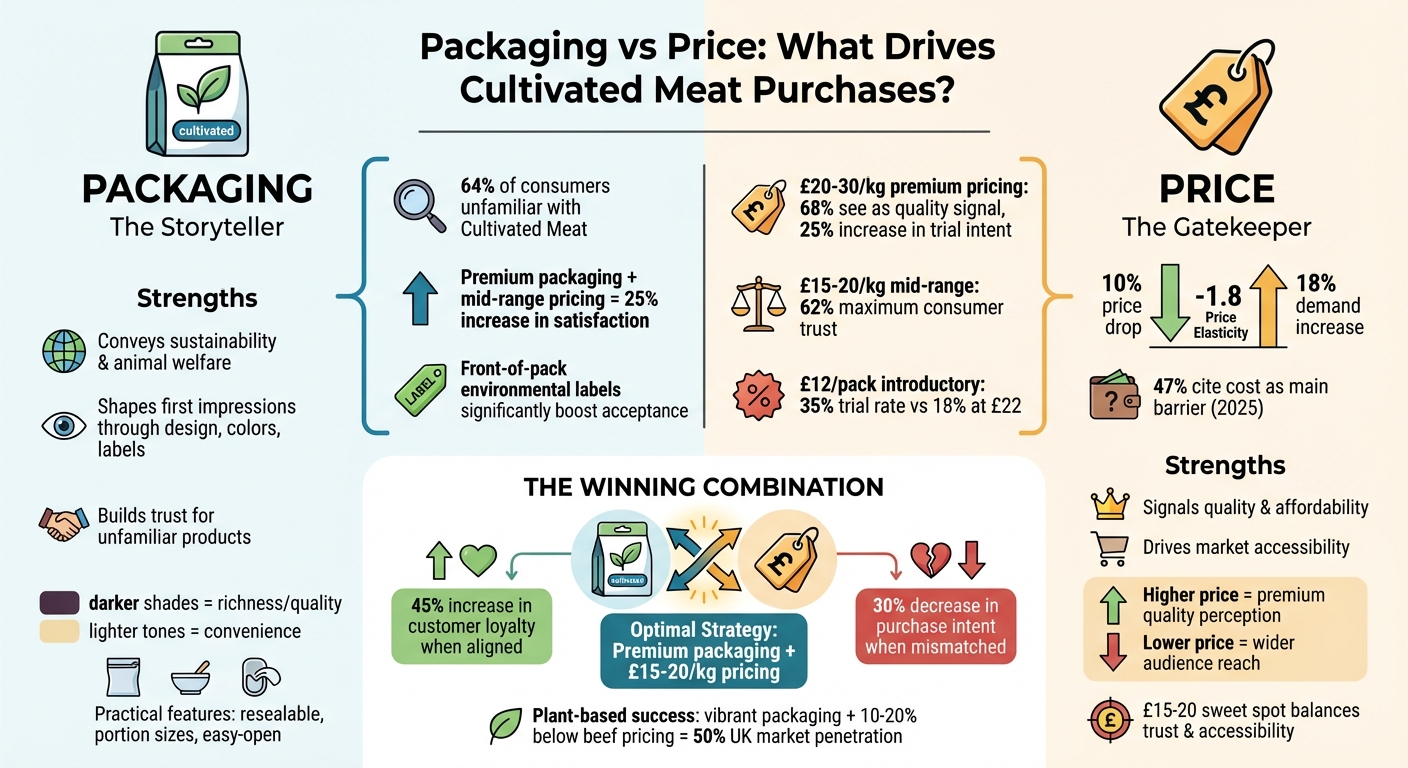
Packaging vs Price Impact on Cultivated Meat Consumer Decisions
When it comes to understanding how packaging design and price influence consumer decisions, comparing their impacts side by side can be revealing. Both factors play distinct roles in shaping factors influencing cultivated meat acceptance. Packaging serves as a storyteller, highlighting messages about sustainability and animal welfare through design and front-of-pack labels. On the other hand, price determines accessibility and affordability for different consumer groups.
A study conducted in 2025 categorised consumers into four segments, each balancing their focus between ethical labelling and economic considerations [1]. While some consumers placed more weight on ethical claims displayed on packaging, others were driven primarily by affordability.
Simulated market studies have shown that well-thought-out labelling strategies can be just as effective as price adjustments in establishing Cultivated Meat in the market [1]. For instance, German trials demonstrated that front-of-pack labels emphasising environmental benefits significantly boosted consumer acceptance. At the same time, price experiments helped identify which consumer groups were most likely to respond to introductory offers [1]. The table below provides a clear comparison of the strengths of packaging and price in this context.
Comparison Table: Packaging vs Price
| Factor | Strengths | Examples in Cultivated Meat |
|---|---|---|
| Packaging | Conveys sustainability and animal welfare; impacts decisions via labelling [1]. | Labels promoting environmental benefits increased acceptance in trials [1]. |
| Price | Drives market accessibility; highlights price-sensitive consumer segments [1]. | Experiments revealed trade-offs consumers made for cultivated chicken pricing [1]. |
How Packaging and Price Work Together
Packaging and price play a key role in shaping how consumers perceive Cultivated Meat. When these two elements align, they inspire trust and enhance satisfaction. But when they don’t match up, consumers may feel uncertain or even misled, which can ultimately affect purchasing decisions. This dynamic highlights the importance of finding the right combination.
Finding the Right Balance
To maximise consumer trust, packaging and price need to complement each other. Aligning the quality of packaging with the price point is crucial. Research into novel proteins reveals that when high-quality packaging is paired with mid-range pricing, satisfaction scores improve by 25% compared to mismatched combinations[9]. For Cultivated Meat, this suggests that packaging emphasising sustainability works best when prices are positioned around £20–30 per kg.
New market players should consider pairing minimalist packaging with tiered pricing to enhance perceived value. This strategy has already proven successful in the plant-based meat sector, where vibrant and transparent packaging combined with introductory prices 10–20% lower than beef and traditional meat equivalents helped achieve 50% market penetration in the UK by 2023[5].
Consumer Satisfaction as the Link
Consumer satisfaction ties together packaging, price, and purchasing decisions by creating positive experiences at every step. For instance, premium Cultivated Meat priced at £22 per kg and presented in appealing packaging can increase customer loyalty by 45%. On the other hand, a mismatch between these elements can decrease purchase intent by as much as 30%[5].
In the UK, platforms like Cultivated Meat Shop are helping consumers understand how packaging and pricing work together to deliver value. By offering educational previews, these platforms prepare shoppers to evaluate combinations effectively. Features like resealable packaging with metric portion sizes and pricing that reflects sustainability benefits resonate with consumers. This approach not only builds excitement for future launches but also sets realistic expectations for balanced packaging and price strategies. Together, these factors pave the way for a deeper exploration of this emerging market.
Conclusion
Packaging and price work hand in hand to shape how consumers perceive value. While packaging establishes trust through its design, functionality, and clear information, pricing communicates quality, fairness, and accessibility. Striking the right balance between the two is essential for converting curiosity into confident purchases.
For shoppers, the focus should be on transparency rather than extremes. Look for packaging that highlights practical details like sustainability, nutritional content, and usability, rather than being swayed by purely aesthetic designs. Similarly, mid-range pricing often offers a better balance of quality and value compared to budget or high-end options.
As discussed earlier, education plays a key role in turning potential confusion into clarity. Cultivated Meat Shop, for example, helps consumers by making packaging and pricing clear indicators of quality and authenticity.
The real value lies in the combination of straightforward packaging and fair pricing. By focusing on honest packaging and reasonable prices, consumers can make more informed choices. When these two elements align, shoppers gain the confidence they need to explore and embrace Cultivated Meat products.
FAQs
What should cultivated meat packaging say to feel trustworthy?
To gain consumer trust, cultivated meat packaging should focus on clarity, quality, and safety. Labels should clearly explain that the product is made from animal cells without the need for slaughter, using straightforward and honest language that anyone can understand. Familiar colours like red and brown can evoke a sense of freshness, while green can subtly hint at eco-friendly practices. Transparent ingredient lists and clear details about how the product is made can further build confidence, helping it feel both trustworthy and approachable.
Is a higher price for cultivated meat actually safer or better?
A higher price tag on cultivated meat doesn’t automatically equate to higher quality or improved safety. Instead, it often mirrors the costs involved in production, compliance with safety regulations, and the hurdles of scaling up operations. Safety, however, is determined by adherence to strict regulatory standards, not by how much the product costs. While early-stage production expenses might drive prices up, cultivated meat is steadily moving closer to matching the cost of traditional meat. Ultimately, what truly matters is transparency in production methods and safety practices, as this is what builds consumer confidence - regardless of the price point.
What’s the best price range for trying cultivated meat in the UK?
The ideal price range for cultivated meat in the UK is estimated to be around £9.25–£10.20 per pound (roughly £20.37–£22.49 per kg). This positions it as a competitor to premium chicken options, though it still costs more than standard chicken. The pricing highlights its status as a high-quality alternative to conventional meat, offering an innovative option for consumers.


