

Cultivated meat is expensive, but CRISPR gene editing offers a way to make it cheaper. By modifying cell lines to grow in serum-free media and replicate indefinitely, CRISPR reduces reliance on costly ingredients like Foetal Bovine Serum (FBS) and improves production efficiency. For example, researchers in 2025 used CRISPR to create porcine cells that thrive in a serum-free medium, cutting costs significantly while improving consistency and scalability.
Key takeaways:
- Serum-free media: CRISPR allows cells to grow without FBS, which is expensive and inconsistent.
- Scalability: Gene-edited cells can reproduce indefinitely, reducing the need for animal biopsies.
- Efficiency: These cells grow faster and produce higher-quality meat-like structures.
While CRISPR has its challenges, such as regulatory hurdles and concerns over genetic effects, it could lower production costs to £2–£4 per kilogramme by 2030, making cultivated meat a viable alternative to traditional meat. This shift could also reduce emissions by 90%, aligning with sustainability goals.
Cost drivers of cultivated meat production
sbb-itb-c323ed3
1. CRISPR Technology in Cultivated Meat Production
CRISPR technology is transforming the production of cultivated meat, making it more affordable and scalable. By engineering cells to grow in cost-effective media and reproduce indefinitely, it tackles the pricing challenges that have long hindered commercialisation.
Serum-Free Media
One of the key breakthroughs enabled by CRISPR is the elimination of reliance on Foetal Bovine Serum (FBS), a costly ingredient in traditional cell culture. Instead, CRISPR-edited cells can thrive in serum-free media. In June 2025, researchers at Nanjing Agricultural University - led by Shijie Ding, Chunbao Li, and Guanghong Zhou - showcased this innovation by developing porcine satellite cells that grew successfully in the A19 medium. This medium contains 19 carefully selected components, including growth factors like bFGF, EGF, IGF-1, and LIF, which support cell growth without animal-derived serum. This approach not only cuts costs but also ensures consistent results [1]. By removing FBS, serum-free media offer a more efficient and ethical solution for cultivated meat production.
Cell Line Scalability
CRISPR also addresses scalability, a critical factor in reducing production costs. By creating "immortalised" cell lines, CRISPR enables cells to multiply indefinitely. The Nanjing team, for instance, used CRISPR/Cas9 to disable the CDKN2A gene in porcine satellite cells, preventing cellular ageing and allowing continuous division. These modified cells maintained over 90% viability and proliferated stably across at least 18 passages, all while retaining their ability to differentiate into mature muscle fibres. This development removes the need for repeated animal biopsies, offering a renewable and consistent cell source for large-scale production [1].
Production Efficiency
These advancements also boost production efficiency. Combining CRISPR-edited cells with serum-free media optimises the entire production process. While serum-free media require specific growth factors, CRISPR-edited cells make these ingredients more cost-effective by increasing output per batch. In the Nanjing study, these cells were seeded onto plant-based 3D scaffolds, resulting in meat-like constructs with improved texture, including better chewiness and gumminess [1]. This integration of technologies enhances both the quality and efficiency of cultivated meat production.
2. Traditional Cultivated Meat Production Methods
Before CRISPR technology entered the scene, the production of cultivated meat was riddled with inefficiencies and sky-high costs, making it tough to compare cultivated and conventional meat prices competitively. Traditional methods relied on expensive inputs and processes that pushed production costs well beyond what consumers would find acceptable.
Growth Factor Costs
A major expense in traditional cultivated meat production comes from recombinant growth factors, which are essential for cell growth and development. Proteins like epidermal growth factor (EGF), fibroblast growth factor (FGF), insulin-like growth factor (IGF), and platelet-derived growth factor (PDGF) replicate the role of animal serum components. These proteins come at an eye-watering price - anywhere from £50,000 to £100,000 per gramme - making up 15–50% of production costs. In early pilot programmes, growth factors accounted for as much as 60–90% of media expenses.
To put this into perspective, optimised media costs around £10 to £20 per litre. For a 500-litre bioreactor, this means a single batch can cost over £100,000. Mosa Meat’s 2013 prototype revealed just how much of a financial burden growth factors impose, accounting for more than 70% of the total costs [2]. On top of the high ingredient costs, these traditional cell lines face serious challenges when it comes to scaling up production.
Cell Line Scalability
Traditional cell lines, often derived from animal myocytes, come with significant limitations. They typically achieve only 20–50 cell doublings, with doubling times of 24–48 hours. This creates a massive efficiency gap when trying to scale from lab-scale volumes (measured in millilitres) to industrial bioreactors holding 10,000 litres or more.
For example, bovine satellite cells can only reach densities of about 10¹² cells per litre, far below the 10¹⁵ cells per litre required for commercial viability. This results in a 100-fold shortfall in efficiency [2]. These scalability issues highlight why more advanced techniques, like CRISPR, have become so transformative.
Production Efficiency
Efficiency is another stumbling block for traditional methods. Cell densities typically range between 10⁷ and 10⁸ cells/ml, with yields of only 5–10 g/L - far below the 50–100 g/L needed to make cultivated meat cost-competitive. A 2022 study showed that unedited bovine cell lines produced just 8 g/L after 14 days. Worse still, the media consumption rates - 1–2 litres per kilogramme of biomass - drive costs up to £50–£100 per kilogramme.
The low oxygen transfer rates and high shear stress in stirred-tank bioreactors further limit yields, achieving only 20–30% of their theoretical potential. This inefficiency leads to 50–70% media wastage, inflating costs by three to five times [2].
"Growth factor dependency and poor cell proliferation limit scalability, with media costs alone at 80% of expenses without genetic tweaks", explains Dr. Ido Hebrew of Aleph Farms [2].
These hurdles make it clear why innovation is so crucial for the future of cultivated meat production.
Advantages and Disadvantages
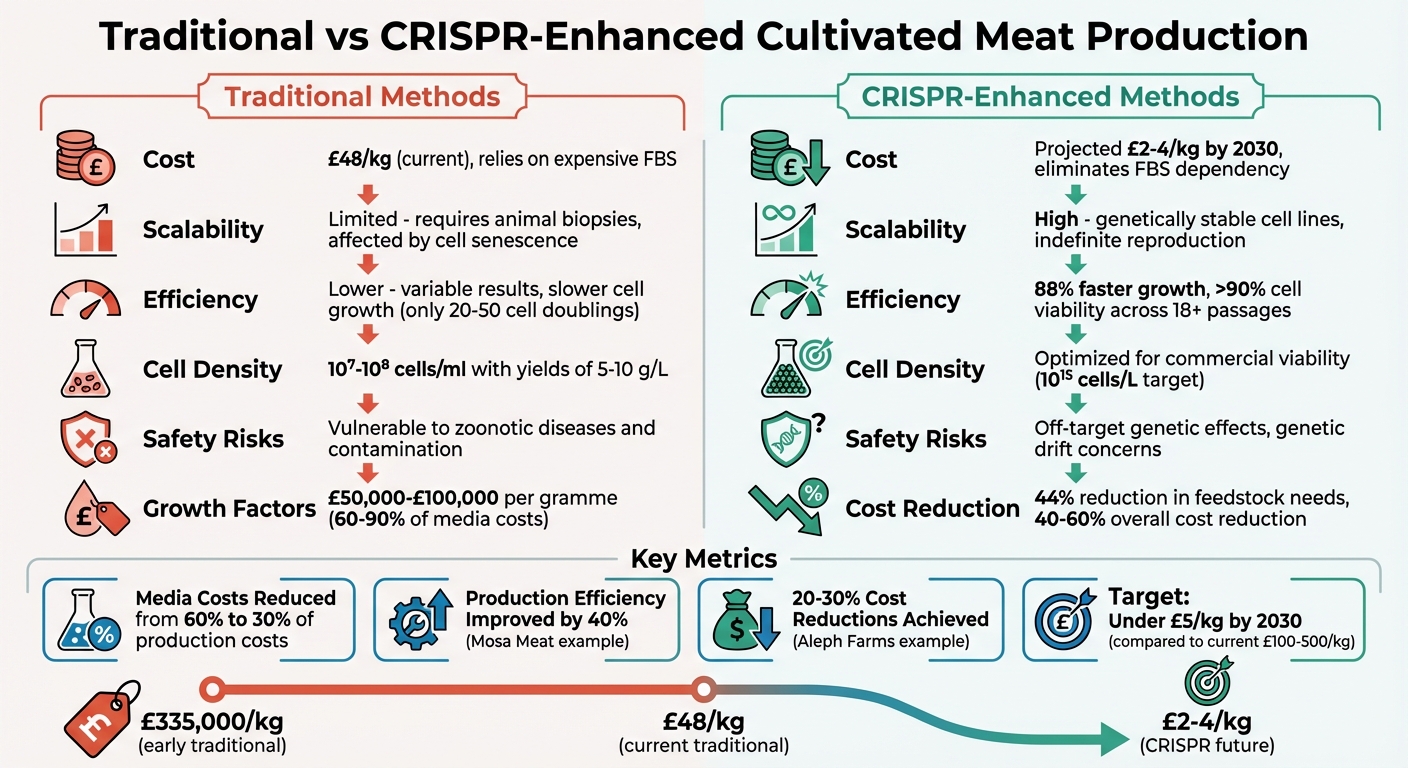
CRISPR vs Traditional Cultivated Meat Production: Cost and Efficiency Comparison
When comparing CRISPR-enhanced methods to traditional techniques in cultivated meat production, the trade-offs are clear. Both approaches bring unique strengths and limitations, particularly when it comes to cost, scalability, and efficiency - factors that heavily influence whether cultivated meat can become affordable on a large scale.
CRISPR-Enhanced Production
CRISPR technology introduces some compelling benefits. By reducing resource inputs and streamlining processes, it addresses significant production challenges. For example, a 2025 study led by Shijie Ding at Nanjing Agricultural University demonstrated the use of CRISPR/Cas9 to create CDKN2A-deficient pig stem cell lines. These cells maintained over 90% viability across multiple passages in serum-free media, solving the problem of cell senescence, where cells lose their functionality after a few doublings [3]. Such advancements could make cultivated meat production more efficient and scalable.
Traditional Methods
On the other hand, traditional methods depend on foetal bovine serum (FBS), which is chemically inconsistent and unreliable for standardised production [3][6]. Currently, large-scale production costs hover around £48 per kilogramme. However, improvements in cell density and bioreactor technology could bring costs down significantly - from a staggering £335,000 per kilogramme to just £1.50 per kilogramme [6].
Challenges and Risks
CRISPR technology isn’t without its drawbacks. Concerns include off-target genetic effects and potential genetic drift during long-term cultivation [4][6]. Additionally, gene-edited foods often face stricter regulatory hurdles and may encounter resistance from consumers wary of genetic modifications [5][6]. Traditional methods come with their own safety risks, such as exposure to zoonotic diseases, microbial contamination, and chemical residues [6].
A Side-by-Side Comparison
The table below summarises the key differences between these two approaches:
| Metric | Traditional Methods | CRISPR-Enhanced Methods |
|---|---|---|
| Cost | High (£48/kg); reliant on costly FBS [6] | Lower; reduces feedstock needs by 44% and eliminates FBS [3][5] |
| Scalability | Limited; reliant on animal biopsies and affected by cell senescence [3][6] | High; allows for genetically stable cell lines suited for mass production [3][6] |
| Efficiency | Lower; prone to variability and slower cell growth [3] | Higher; 88% faster growth with over 90% cell viability [3][5] |
| Safety Risks | Vulnerable to zoonotic diseases and contamination [6] | Concerns over off-target effects and genetic drift [4][6] |
Each approach brings its own set of opportunities and hurdles, making the choice between them highly dependent on specific production goals and external factors like regulatory landscapes and consumer attitudes.
Conclusion
CRISPR technology is reshaping the cost landscape for cultivated meat, directly addressing one of the industry's biggest financial hurdles - growth media. This component currently accounts for about 60% of production costs, but with gene editing, this could shrink to just 30%, thanks to more efficient cell lines [7][11]. The result? A potential overall production cost reduction of 40–60%, bringing prices down from an eye-watering £100–500 per kilogramme to under £5 per kilogramme by 2030 [7][10].
There’s already proof of concept in action. Aleph Farms has used CRISPR to modify bovine cells, enhancing fat accumulation and growth, which has led to 20–30% cost reductions. Similarly, Mosa Meat’s genetically modified cell lines have boosted efficiency by 40%, bringing production costs closer to £10–15 per kilogramme [9][11].
"CRISPR unlocks scalable economics", says Dr. Ido Hebrew from Future Meat Technologies, with commercial launches in the UK anticipated by 2028 [9][12].
By addressing growth media costs, CRISPR could slash production costs to £2–4 per kilogramme, aligning cultivated meat prices with traditional UK beef wholesale rates of £8–12 per kilogramme [8][13]. Tufts University experts predict that combining multiple genetic edits could achieve this within 5–7 years, with tenfold improvements in yield [8][13].
Of course, challenges remain. Regulatory barriers under UK GMO rules need navigating, and off-target effects must be monitored. However, recent trials using advanced Cas9 variants have achieved over 95% precision in targeting [10][14]. These developments position cultivated meat as a competitive option in the UK market, offering the added benefit of 90% lower emissions alongside affordable pricing [8][13]. As these breakthroughs reshape the market, platforms like Cultivated Meat Shop are helping consumers embrace this shift from lab to table by fostering awareness and interest.
FAQs
Is CRISPR-edited cultivated meat legal in the UK?
The legal status of CRISPR-edited cultivated meat in the UK remains uncertain. The Food Standards Agency is actively assessing the safety of cell-cultivated products, with results anticipated within the next two years.
Will CRISPR make cultivated meat as cheap as conventional meat?
CRISPR technology is making strides in cultivated meat production, particularly through advancements like better cell line engineering and cutting down on growth factor expenses. These developments are driving down production costs, inching cultivated meat closer to matching the price of traditional meat. With continued progress, it could one day become just as affordable.
Is CRISPR-edited cultivated meat safe to eat?
Yes, CRISPR-edited cultivated meat is deemed safe for consumption. Thanks to progress in cell culture technology and stringent regulatory oversight - such as reviews conducted by the FDA and FSIS - its safety is thoroughly assessed. These processes ensure that cultivated meat adheres to strict standards, including proper labelling, to protect consumer health.


