

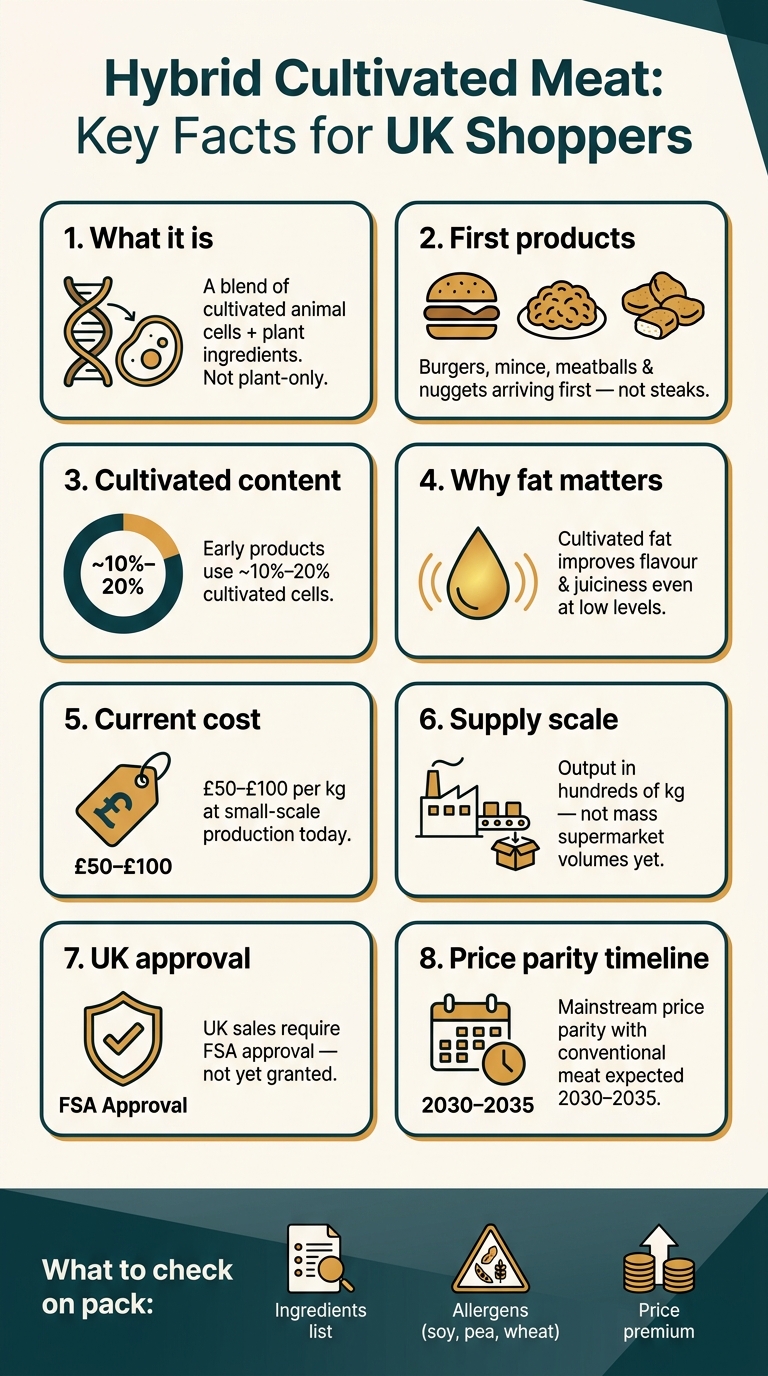
Hybrid cultivated meat is likely to reach UK shoppers first in burgers, mince, meatballs and nuggets - not steaks. That’s because early products can use a small share of cultivated cells, often around 10%–20%, mixed with plant ingredients to improve flavour, fat and juiciness without the cost of making a full meat cut.
If I boil this guide down, here’s what matters most for you:
- Hybrid means a mix of cultivated animal cells and plant ingredients
- It is not plant-only, because it still contains meat cells
- First products will likely be simple formats such as burgers, mince, meatballs and coated bites
- Cultivated fat may appear first, as it can shift taste and texture even at low levels
- Cost is still high, with small-scale cultivated meat estimated at £50–£100 per kg
- Supply is still limited, with output in hundreds of kilograms, not mass supermarket volumes
- UK sales still depend on FSA approval
- Mainstream price parity is not expected until 2030–2035
For everyday shopping, I’d look at three things first: ingredients, allergens, and price. If these products arrive in UK shops, the label should show how the cultivated and plant parts are used, while soy, pea or wheat may matter for allergies or food choices.
This guide gives a plain-English view of what hybrid cultivated meat is, why brands are starting with blends, and what UK shoppers may see first.
Hybrid Cultivated Meat: Key Facts for UK Shoppers
Product development in cultivated meat: Why hybrid products will likely be the first step to market
sbb-itb-c323ed3
What Hybrid Cultivated Meat Means
A hybrid Cultivated Meat product blends real animal cells with plant ingredients in the same food. So it isn't plant-only. It still contains meat, but that meat is grown from cells rather than taken from a slaughtered animal.
That sets it apart from products that combine conventional meat with plant ingredients. Hybrid Cultivated Meat uses cells grown in controlled conditions instead.
How A Hybrid Product Is Made
Cultivated Meat begins with a small sample of cells taken from a living animal. Those cells are then grown in a bioreactor - a controlled vessel made to support cell growth. Once enough cultivated muscle or fat has been produced, it can be used as one ingredient in a finished food product.
That cultivated ingredient is then mixed with plant proteins such as soy, pea, or wheat, along with oils, binders, and seasonings. The plant side gives the product structure and bulk, while the cultivated cells add meat flavour and juiciness.
Why A Small Amount Can Change Taste And Texture
Early hybrid products may use about 10% to 20% cultivated ingredient [1]. That may sound like a small share, but it can still shift flavour, juiciness, and aroma in a noticeable way.
A lot of that comes down to cultivated fat. Fat carries savoury aroma and helps create the juicy bite that plant proteins on their own often miss. So even a modest amount can change how the product tastes and feels.
That helps explain why the first products are likely to be familiar formats like burgers and mince.
Which Hybrid Products May Reach Shoppers First
Early hybrid products will probably show up in simple, familiar formats. Why? Because these products can work with a small amount of cultivated ingredient, and that makes blending much easier. The first hybrid Cultivated Meat products are most likely to be mince-style and other simple formats, since they’re far easier to combine with plant ingredients than structured cuts.
Burgers, Mince And Meatballs
Burgers, mince and meatballs are the clearest early candidates. Cultivated cells can be mixed with plant-based ingredients without the added challenge of building structured tissue. That fits everyday UK cooking well, where mince already has a place in meals people know and make all the time.
Nuggets, Bites And Coated Products
The same idea carries over to nugget-style products. In these formats, coating and seasoning do much of the heavy lifting. Nuggets and coated bites suit hybrid formulations because they don’t need the structure of whole cuts such as steaks or fillets. Singapore's approval of cultivated chicken in December 2020 - the first approved in the world - was granted for a nugget format [1][2], which gives a clear hint about where the tech is furthest along and where shoppers are most likely to feel at ease with what they’re buying.
Why Cultivated Fat May Come First
There’s another reason these formats make sense: cultivated fat. It can add flavour without the need for a complex structure. Cultivated fat may come first because it’s easier to use than structured muscle and can improve flavour and juiciness fast. For brands, that makes it a practical starting point. It helps with taste and texture without adding much extra complexity.
Why Brands Use Hybrid Blends
Once the first formats are locked in, the next step is simple: why use blends in the first place? For many brands, hybrid blends are the most practical way to get to market sooner. They can also help on price, taste and nutrition.
Lower Cost And Easier Route To Market
Producing Cultivated Meat at scale is still expensive. Current small-scale production costs are estimated at £50–£100 per kg[1]. So instead of using a full portion of cultivated material, brands can use a smaller share and blend it with plant-based ingredients. That gives them a better shot at reaching price points shoppers may accept, even while costs still sit well above those of conventional meat.
There’s also a plain supply issue. Production capacity is still tight, with facilities making hundreds of kilograms rather than thousands of tonnes[1]. Hybrid products give brands a way to launch with the cultivated material they can actually make today. In practice, that means a shorter route to market while supply stays limited[1].
Better Taste And A More Familiar Eating Experience
Cost isn’t the only reason. Hybrids can also help close the gap with conventional meat on flavour, juiciness and texture. Hybrid blends balance price with taste and mouthfeel[1][2].
The logic is pretty straightforward: use the cultivated ingredient where it matters most to the eating experience. That usually means flavour, aroma and juiciness[1][2]. Done well, the product feels less like a compromise and more like something people already know how to enjoy.
Nutrition And Ingredient Balance
Blends also give brands more control over the final nutrient profile. A hybrid product can combine meat nutrients such as heme iron, protein and vitamin B12 with fibre from peas or faba beans[2].
Brands can also adjust fat and nutrient levels during formulation[2]. That makes blends useful not just for cost and taste, but for shaping what ends up on the nutrition label.
What Hybrid Cultivated Meat Could Mean For Everyday UK Shopping
How Hybrids Can Support Lower-Impact Meal Swaps
Once brands land on a blend that works, the next thing people care about is simple: what does this mean in the weekly shop?
Hybrid Cultivated Meat products could make it easier to stick with familiar meals like burgers, mince and nuggets while picking something that uses less land and water than standard meat. That’s what makes hybrids a practical lower-impact meal swap.
What To Look For On Pack: Ingredients, Price And Cooking
When hybrid Cultivated Meat products finally reach UK shops - and that still depends on Food Standards Agency (FSA) approval - the ingredient list will be one of the first things to check. It can tell you how the cultivated and plant-based parts are listed, and whether the pack shows the cultivated-meat percentage.
It’s also worth checking the plant-based side of the product. If it uses soy, pea or wheat, that can matter a lot for allergies or for your own food preferences.
Hybrid products are designed to cook, brown and sizzle like conventional meat because they contain animal fat and muscle cells [2].
Price matters too, of course. Early products are likely to come in at a premium, and comparing prices with standard supermarket meat is not expected until the 2030–2035 window [1].
For UK shoppers, the next move is pretty clear: keep an eye on approved launches and read labels with care.
Following New Products With Cultivated Meat Shop
For UK shoppers, Cultivated Meat Shop tracks launches, product previews and waitlist sign-ups. It’s a practical place to stay informed as the category grows.
Conclusion: Key Takeaways On Hybrid Cultivated Meat
Hybrid Cultivated Meat blends cultivated cells with plant ingredients. That makes it simpler to bring to market than fully cultivated whole cuts. So the first products are more likely to show up in simple, familiar formats rather than steak-style pieces.
In the UK, the first products will most likely be burgers, mince, meatballs and nuggets, because these formats don't need whole-cut structure. They also make the blend easier for brands to work with.
Brands lean on blends because using fewer cultivated cells cuts cost and makes retail launches more practical. For shoppers, that matters most when it turns up in everyday meals people already know how to cook and eat.
For UK shoppers, hybrids could slot into meals they already buy while offering a lower-impact swap compared to traditional beef. Until UK approval arrives, as part of the growing global momentum in the industry, you can follow new launches and product updates through Cultivated Meat Shop.
FAQs
Will hybrid Cultivated Meat taste like normal meat?
Yes. Hybrid Cultivated Meat is made to taste like conventional meat because it contains real animal cells. Those cells help deliver the flavour, aroma and texture people expect from meat.
By blending cultivated cells with plant-based proteins or conventional meat, brands can balance cost, texture and sustainability while keeping a more natural meat-like eating experience. Early taste tests have been very positive.
Is hybrid Cultivated Meat suitable for vegetarians?
No. Hybrid cultivated meat is not suitable for vegetarians because it contains real animal cells. That means it’s still a food of animal origin.
It may be pitched as a more ethical alternative to standard meat, but it is still genuine meat. So if you follow a vegetarian or vegan diet, it would not count as meat-free.
How will hybrid Cultivated Meat be labelled in UK shops?
Labelling for hybrid Cultivated Meat in UK shops is still still being worked out. These products fall under novel foods, so there isn’t yet a fixed naming rule or a clear supermarket aisle for them.
As the Food Standards Agency builds its framework, the way these products need to be described to shoppers will likely change too. For updates as products get closer to launch, Cultivated Meat Shop shares educational resources.


