

Reusing nutrients could cut cultivated meat waste - but only if treatment saves more resources than it uses. A 2023 model estimated that around 76% of supplied nitrogen could leave as waste without recovery. Before reuse, treated medium needs checks for contamination, nutrient balance and dissolved waste.
Cultivated meat is grown from animal cells in a nutrient-rich liquid called culture medium. Keeping those nutrients in use involves six steps:
- Recover unused nutrients: Separate reusable ingredients from waste, then replace what cells have consumed.
- Use perfusion streams: Continuous medium outflow provides liquid for recovery, but does not recycle it by itself.
- Control ammonia and lactate: Remove or limit waste products that can hinder cell growth.
- Test microalgae routes: Algae could turn leftover nutrients into ingredients for new medium.
- Monitor each reuse cycle: Check nutrients, waste, contamination and cell performance before returning medium to production.
- Measure results at scale: Compare costs, energy, water and waste with a process using only new medium.
Lab results show promise, not proof of commercial savings. Each system must show safe, steady production and lower total resource use.
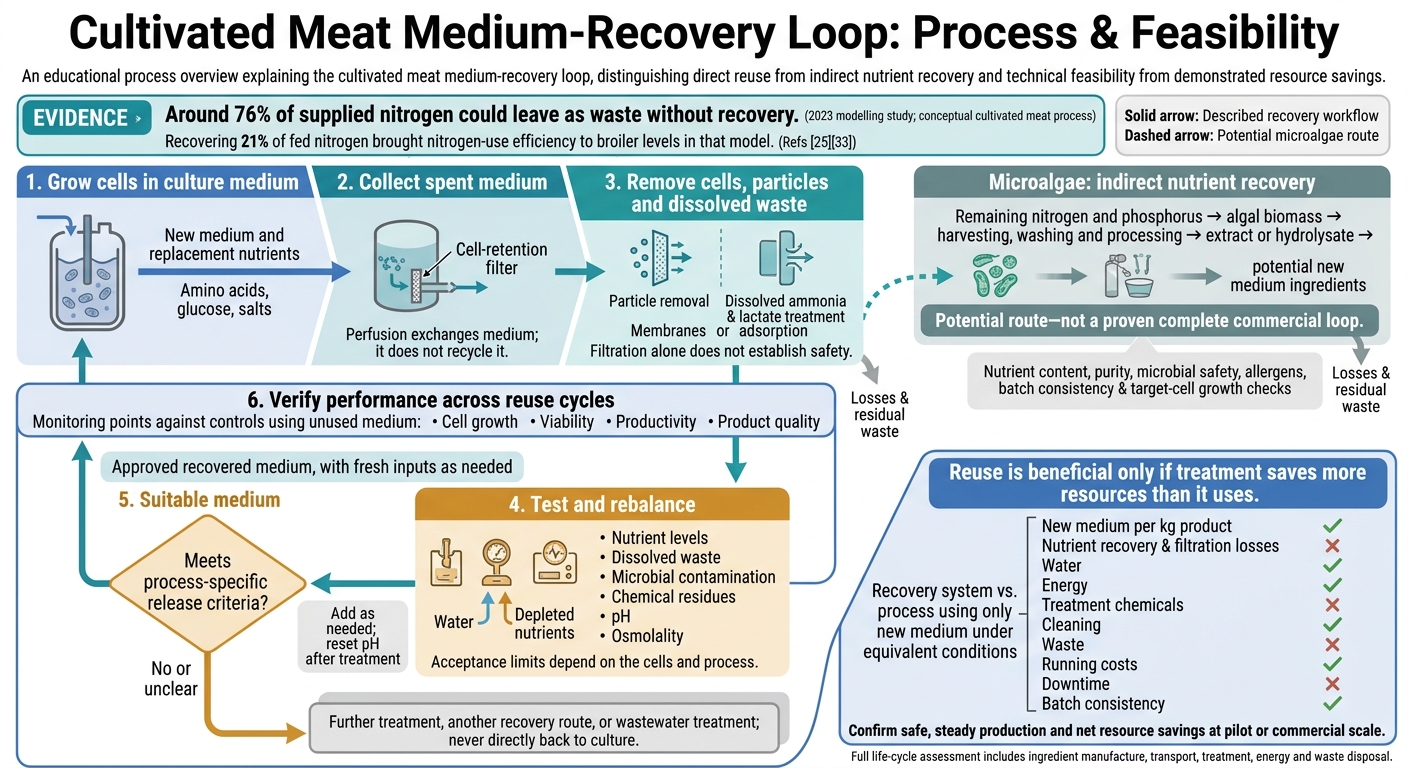
How Circular Media Recovery Works in Cultivated Meat
How Medium Recovery Works
Spent medium still contains usable amino acids, glucose and salts, along with ammonia and lactate.[4][7] Recovery means separating what can be reused from what must be removed.
Operators collect spent medium at harvest or through continuous outflow, then remove cells and particles. But particle removal alone isn’t enough. Membranes or adsorption can remove dissolved waste while retaining useful ingredients.[3][6][7]
The recovered liquid is tested for essential bioreactor metrics like nutrient levels, contamination, pH and osmolality. Operators then top it up with water and nutrients before reuse.[3][6][8]
A circular system is rarely fully closed. Some ingredients are consumed or break down, and processing causes further losses. Unusable material may need another recovery route or wastewater treatment. When checking a recycling claim, look at whether it covers water, specific nutrients or total medium - and the form and amount recovered.[3][5] The next question is how much waste recovery can prevent by reducing demand for new inputs.
sbb-itb-c323ed3
1. Recovering Unused Nutrients Could Reduce Waste
Circular media systems recover nutrients before they leave the process. Selective recovery after treatment could cut waste and reduce demand for new inputs by keeping nutrients in circulation.[11][13]
A 2023 modelling study found that around 76% of supplied nitrogen could leave as waste without recovery. Recovering 21% of fed nitrogen brought nitrogen-use efficiency to broiler levels in a conceptual Cultivated Meat process.[11][19]
Operators analyse the stream, remove inhibitors, replace depleted nutrients and blend the treated fraction with new medium.[12][14] Checks should cover nutrient concentration, pH, osmolality, sterility and impurity levels. They should also compare growth, viability, productivity and product quality against results from new medium.[12][15][16]
Nitrogen recovery only cuts the overall resource burden if treatment uses less water, energy and chemicals than it saves.[11][16][17] Reliable recovery could reduce the inputs needed for future nuggets, mince and seafood. Continuous recovery streams, such as those created by perfusion, offer a way to test this.
2. Perfusion Creates a Stream for Recovery
Perfusion provides a stream of medium that could be recovered. It feeds new medium into the vessel while a cell filter or membrane holds the cells in place. The outflow carries waste and unused nutrients.[20][22][24]
Unlike batch or fed-batch bioreactor designs, perfusion removes medium continuously. This helps limit ammonia and lactate build-up and keeps conditions stable.[21][22][23]
Perfusion exchanges medium; it does not recycle it. Without recovery, it can use more new medium. Before the outflow can be reused, it needs treatment, testing and approval.[20][23][26]
Whether that stream can be cleaned enough for safe reuse depends on waste control.
3. Reuse Requires Ammonia and Lactate Control
Reusing medium means first controlling its main waste products: ammonia and lactate. Ammonia commonly forms during amino-acid metabolism, while cells produce lactate when they process glucose. If either builds up, it can inhibit cell growth and activity, making the medium less suitable for reuse.[25]
Increasing the pH helps remove ammonia from the liquid. A 2025 study found that treatment at pH 12 for 15 minutes removed over 82% of ammonia while preserving glucose. The treated medium supported lamb cell growth when mixed 50:50 with fresh medium. But that result applied to the study’s conditions - it is not a universal standard.[28][27]
Lactate needs a different approach. Here, the evidence comes from a process model, not a commercial trial. A five-step route using membrane separation and adsorption projected a lactic acid by-product at 88% concentration.[12]
Before reusing the medium, operators must reset its pH and retest it. Safe limits depend on the cell type, medium formulation, feeding strategy and bioreactor conditions, so each reuse cycle needs monitoring to solve consistency issues.[25][27]
4. Microalgae Could Turn Recovered Nutrients into New Inputs
When spent medium cannot be reused directly, microalgae offer another way to recover its remaining nutrients. They absorb nitrogen and phosphorus and turn them into biomass, which can then be processed into new ingredients. This is indirect nutrient recovery, not direct medium reuse.[9]
After harvesting, the biomass can be washed, separated and processed into an extract or hydrolysate. This could supply some amino acids, peptides and other medium ingredients.[18][9]
But can these algal ingredients support Cultivated Meat cells? A 2023 Scientific Reports study found that Chlorella vulgaris extract could support bovine myoblasts in serum-free medium. The finding shows potential, but it does not establish a complete recycling loop or commercial use.[29]
Before use, test recovered algal ingredients for nutrient content, purity, microbial safety, allergens and batch consistency. Then confirm that they support growth in the target Cultivated Meat cells.[18][9] Additional nutrients may still be needed as nitrogen and phosphorus levels decline.[1][10] Measuring the energy used for lighting, harvesting and processing would help establish whether the process delivers net resource savings.
5. Monitoring Helps Control Medium Reuse
After medium is recovered, monitoring determines whether it can safely return to the process. Glucose, amino acid and glutamine readings show nutrient use. Lactate and ammonium readings track waste build-up, while cell density and viability indicate culture health.[33][34]
In-line or at-line sensors give fast readings. Samples taken through closed sampling ports allow a broader range of laboratory checks. Sensors need calibration and periodic checks against laboratory methods. Process models combine these results with flow rates and viable-cell density to predict nutrient shortages and waste accumulation.[31][32] The results help operators decide whether the stream needs more waste removal before reuse.
Before returning medium to culture, operators check that nutrient and dissolved-waste levels meet limits set for the cells and process, rather than limits copied from another system.
Filtration alone does not establish safety: dissolved lactate and ammonium can remain.[35] Microbiological checks detect contamination that nutrient readings miss. Batches that fail release criteria, or have unclear results, should not return to culture.[36]
As the system moves closer to reuse, monitoring needs to become tighter. Methods vary with cell type, bioreactor design and sensor maturity.[32][34] Some systems may use continuous sensing and automated control. Others rely on scheduled sampling and manual replenishment during development. Increase reuse only when growth, productivity and quality match controls using unused medium.
6. Future Products Need Reliable, Efficient Reuse
Once reuse can be monitored safely, the next test is whether it saves resources at scale. Using less medium only helps if recovery costs less than it saves. That means assessing the full recovery loop, not just the medium bill.
Tests should track:
- New medium used per kilogram of product, nutrient recovery rate and nutrient loss during filtration.
- Waste produced, treatment chemicals, energy use and cleaning requirements.
- Line downtime and batch consistency.
Reuse should be compared with a single-use process under equivalent conditions. The comparison must include contamination checks, stable cell performance, ingredient quality and total resource inputs.
Each claim needs pilot- or commercial-scale evidence covering running costs and system performance. An independent life-cycle analysis should account for ingredient manufacture, transport, treatment, energy and waste disposal. Lab results alone cannot prove that the system as a whole reduces its impact on the environment.
For everyday products such as future Cultivated Meat nuggets, mince and seafood, reliable reuse needs separate proof of performance and resource savings because cell types and processes differ.
Conclusion: Reuse Needs Safety Checks and Resource Evidence
Circular media systems recover useful nutrients from spent cultivation medium, remove unwanted by-products and return tested components to Cultivated Meat production.[11]
Before reuse, treated medium still needs checks for microbial contamination, chemical residues, nutrient balance, pH and osmolality.[2][30]
But technically possible reuse does not automatically mean lower impact. Treatment efficiency, energy use, ingredient sourcing and production scale all affect the outcome. Filtration, sterilisation and pumping can cancel out savings, while new nutrients may still be needed. Systems must show net reductions in total inputs and waste at scale.[14][37]
Recovering nutrients alone does not prove that a medium is suitable for reuse. That requires testing, alongside evidence that reuse is efficient.
FAQs
Could recycled nutrients affect Cultivated Meat’s taste?
Yes, recycled nutrients in the growth media - the mixture that supports cell growth - could affect Cultivated Meat’s flavour, aroma and texture. Changes to the mixture can alter its savoury qualities, depth of flavour and firmness.
Researchers are working to balance nutrient reuse with product quality. Their aim is to cut waste and costs while keeping the taste and texture consumers expect.
How many times could culture medium be reused?
There’s no fixed number of times culture medium can be reused in Cultivated Meat production. Reuse is still experimental, rather than standard industry practice.
At Cultivated Meat Shop, we follow research into how reusing culture medium could reduce resource use. Any reuse requires rigorous testing to meet strict food safety, sterility and regulatory standards - and to confirm consistent product quality and cell growth.
Could medium reuse make Cultivated Meat cheaper?
Yes, reusing growth medium could make Cultivated Meat more affordable. It would reduce the amount of costly nutrients and ingredients needed per kilogram. Growth medium makes up a large share of production costs, so using it more than once could help cut costs.
But reuse is still experimental. Strict checks are needed to maintain nutrient levels, prevent contamination and protect product quality. Cutting waste and making better use of resources could also help bring Cultivated Meat prices closer to those of conventional meat.


