

When it comes to cultivated meat, awareness is low - only 2% of UK consumers understand what it is, and 57% have never heard of it. With products expected in the UK by 2026 or 2027, both producers and retailers play key roles in educating the public.
- Producers focus on tastings, media campaigns, and partnerships to showcase the science and benefits of cultivated meat.
- Retailers prioritise consumer education, offering resources, product previews, and waitlists to normalise it as part of daily life.
Each approach has strengths and challenges: producers provide sensory proof but face high costs, while retailers reach a broader audience but lack direct engagement tools like tastings. Both must work together to bridge the gap between curiosity and acceptance.
| Aspect | Producers | Retailers |
|---|---|---|
| Focus | Science and product demonstrations | Education and accessibility |
| Key Tactics | Tastings, events, media campaigns | Online resources, waitlists |
| Challenges | High costs, regulatory hurdles | Scepticism, limited availability |
Both are essential to making cultivated meat a trusted, everyday option.
Understanding Emerging Perceptions of Cultured Meat: A Mind Genomics Approach
sbb-itb-c323ed3
How Producers Build Awareness
Producers are taking a proactive approach to build trust and awareness for cultivated meat. Through public events, media collaborations, and partnerships, they aim to show consumers that this is not some far-off concept but actual, tangible food. By creating opportunities for people to taste and experience the product, they hope to move it from the realm of science fiction into everyday reality. Here's a closer look at how tastings, media efforts, and partnerships are helping to build consumer confidence.
Tastings and Public Events
One of the most direct ways producers engage with the public is through tastings. A standout example occurred in June 2024 when UPSIDE Foods hosted the "Freedom of Food Pop-Up" in Miami, Florida. This event, held just days before a state-level ban on cultivated meat, was led by CEO Dr. Uma Valeti and Chef Mika Leon. It featured 75 samples of cultivated chicken tostadas, complete with guacamole and chipotle aioli. Attendees had to sign a petition against the ban to participate, turning the event into both a tasting and a statement on "food freedom" [5].
These events go beyond just sampling - they create a full sensory experience. At the Miami pop-up, attendees could watch the cooking process live via an overhead stream, offering a transparent look at how the product is prepared [5]. This type of hands-on interaction helps reinforce the authenticity of cultivated meat and addresses scepticism head-on.
Media Campaigns and Partnerships
Media coverage and strategic partnerships are another cornerstone of awareness-building efforts. Producers account for about 75% of media coverage in the sector, using milestones like product launches or investment announcements to highlight benefits related to animal welfare and environmental concerns [7]. The sector’s growth is evident in the numbers: investment rose from £1.6 million in 2015/2016 to nearly £40 million by 2018 [7], reflecting increasing confidence in cultivated meat technology.
To build culinary credibility, producers initially teamed up with fine-dining establishments and celebrity chefs. These partnerships positioned cultivated meat as an exclusive, gourmet ingredient, helping to shape its image before attempting broader market expansion [5][6]. Media analysis also shows that positive stories about cultivated meat far outweigh cautionary ones in traditional news outlets, which helps maintain a favourable public narrative [7].
Obstacles Producers Face
Despite these efforts, producers face several challenges. High production costs and complex regulatory frameworks are significant barriers [5][9]. Regulatory processes are often fragmented, and state-level bans, like the one in Florida, add further complications [9]. Public tastings, while impactful, are expensive and hard to scale. For example, UPSIDE Foods and GOOD Meat served fewer than 100 servings each in the U.S. before ending their fine-dining partnerships, limiting how many people could experience the product firsthand [5].
Another major hurdle is educating the public on safety and the production process. Concerns about batch contamination can erode trust [8][9]. Additionally, many event attendees express confusion about how cultivated meat is made, from cell to finished product, which fuels scepticism [5]. Without clear, accessible explanations, gaining widespread trust remains an uphill battle.
How Retailers Build Awareness
Retailers focus on educating consumers, making cultivated meat accessible, and integrating it into everyday life rather than relying on tastings or media tie-ins. While they don’t produce cultivated meat themselves, their role in shaping the market is pivotal. They help transform it from a niche concept into a legitimate food choice, paving the way for broader acceptance. This approach complements the more direct strategies used by producers by addressing the practical needs of everyday shoppers.
Educational Content and Resources
Retailers have a unique advantage: they connect with consumers during their regular shopping routines. Platforms like Cultivated Meat Shop provide detailed, science-backed content to explain how cultivated meat is made, its health benefits, taste, and safety, and its impact on the planet. This effort is vital, as a significant knowledge gap exists - only 2% of UK consumers know what "cultivated meat" is, while 57% have no idea how it’s produced [4].
Jaczniakowska-McGirr, Director of Corporate Engagement at ProVeg International, highlighted this opportunity:
"This showed that, as an industry, we have a good opportunity to shape future perceptions" [4].
Retailers can influence these perceptions by carefully choosing their language and visuals. For instance, using the term "cultivated" instead of "lab-grown" avoids negative associations with artificiality [3]. Imagery plays a role too: 49% of consumers found food-based photos of cultivated meat appealing, compared to 43% for lab-based ones. Similarly, 47% thought cultivated meat looked "tasty" in food-based images, while only 35% felt the same about lab-focused visuals [4].
Waitlists and Product Previews
Since cultivated meat isn’t yet available in UK stores, retailers are building anticipation through waitlists and sneak peeks. Platforms like Cultivated Meat Shop offer early notifications and pre-order options, keeping consumers engaged and curious. This strategy sustains interest without requiring costly events and also helps retailers gauge demand. Product previews, showcasing options like cultivated chicken, beef, or seafood, keep the topic relevant and give consumers a taste - at least visually - of what’s to come.
Retailer Strengths and Limitations
Retailers bring scale and accessibility to the table. They can seamlessly integrate cultivated meat into daily shopping, offer extensive online and in-store resources, and leverage their established brand trust [3]. As the Sustainability Directory notes:
"The retail sector finds itself at a critical juncture, navigating the introduction of such novel food products while simultaneously striving for greater sustainability" [3].
However, they also face challenges. Unlike producers, retailers can’t easily provide sensory experiences like tastings, which are key to overcoming scepticism and hesitation around new foods [3]. There’s also a tricky cycle: low consumer demand and high initial costs make retailers cautious about dedicating shelf space. This keeps cultivated meat confined to niche markets [3]. Additionally, retailers must carefully manage their messaging to avoid fuelling fears of "unnatural" foods, often amplified by sensational media narratives [3].
| Factor | Strength | Limitation |
|---|---|---|
| Consumer Reach | High; integrates into daily shopping habits. | Limited by high costs and niche availability. |
| Education | Broad online and in-store resources. | Lacks direct sensory experiences like tastings. |
| Trust | Leverages established brand reputation. | Vulnerable to negative "Frankenfood" narratives. |
| Market Impact | Normalises cultivated meat as a staple. | Hesitant to stock due to uncertain consumer demand. |
Despite these hurdles, retailers play an indispensable role in preparing the market. Their ability to normalise cultivated meat and provide consistent, accessible education complements the more direct engagement strategies used by producers.
Producers vs Retailers: A Direct Comparison
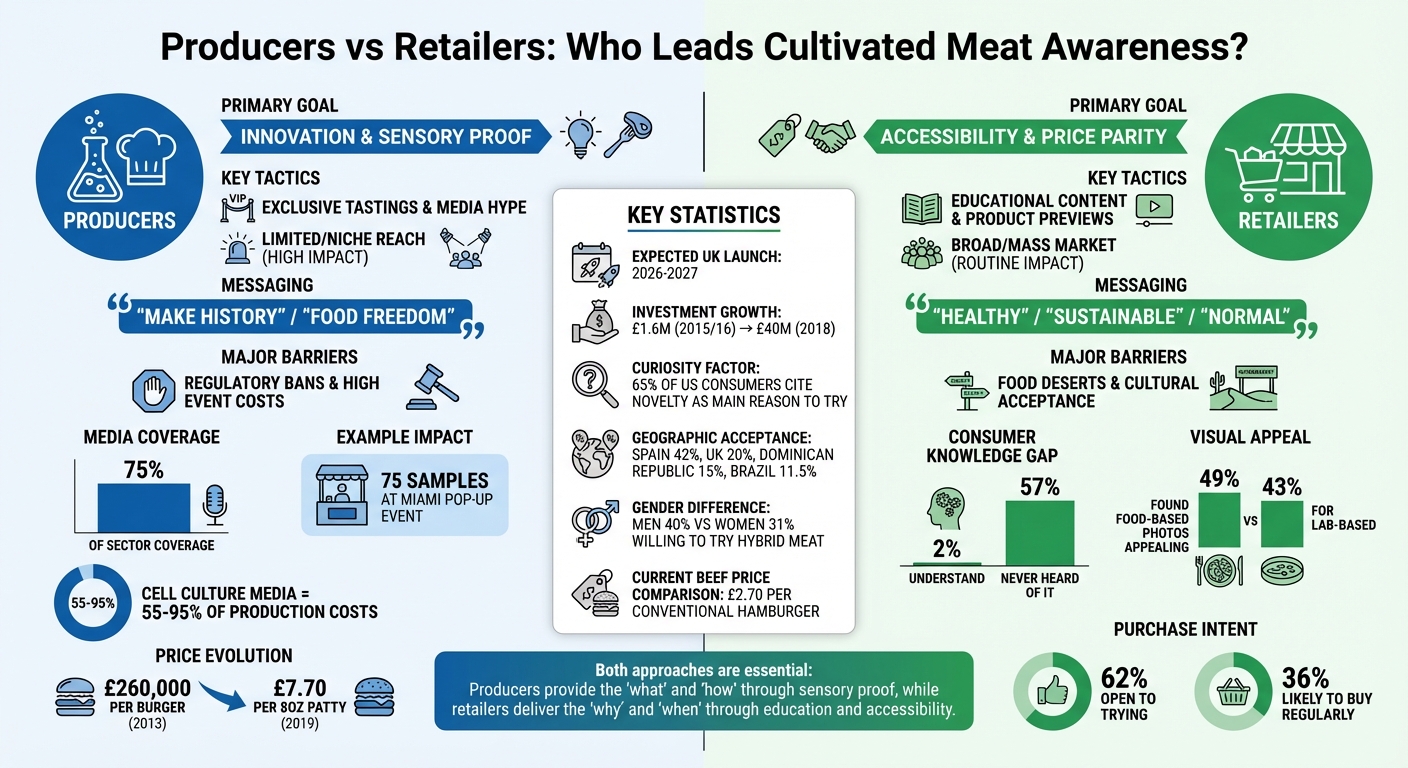
Producers vs Retailers: Cultivated Meat Awareness Strategies Comparison
Strengths and Weaknesses Compared
Producers and retailers approach consumer awareness from entirely different angles. Producers focus on showcasing that the product works, often through tastings and high-profile events. Retailers, on the other hand, aim to make cultivated meat a familiar part of everyday life by using educational content and strategic product placement. Each method comes with its own strengths and challenges, shaping how consumers interact with and perceive cultivated meat. The table below highlights these contrasting approaches.
| Feature | Producer Approach | Retailer Approach |
|---|---|---|
| Primary Goal | Innovation & sensory proof | Accessibility & price parity |
| Key Tactic | Exclusive tastings & media hype | Educational content & product previews |
| Messaging | "Make history" / "Food Freedom" | "Healthy" / "Sustainable" / "Normal" |
| Major Barrier | Regulatory bans & high event costs | Food deserts & cultural acceptance |
| Reach | Limited/niche (high impact) | Broad/mass market (routine impact) |
A great example of the producer approach was UPSIDE Foods' tasting event in June 2024. It showed how producers can create memorable sensory experiences, even with the challenges of cost and limited reach [11]. Tastings like this are an effective way to address food neophobia by letting people experience the product firsthand. But they are expensive and geographically constrained.
Retailers, such as Cultivated Meat Shop, take a different route, reaching thousands of consumers through online platforms, waitlists, and product previews. However, they lack the sensory proof tastings provide, which is crucial for solving taste challenges. A 2020 survey revealed that while 62% of respondents were open to trying cultivated meat, only 36% said they’d likely purchase it regularly [14].
The issue of cost is another major dividing line. Producers face steep financial challenges, with cell culture media accounting for 55–95% of production costs. Prices have dropped dramatically - from £260,000 for a burger in 2013 to around £7.70 for an 8-ounce patty by late 2019 [13]. Still, conventional beef remains far cheaper, costing approximately £2.70 per hamburger [13]. Retailers must contend with this pricing gap while also addressing consumer scepticism about the "unnaturalness" of cultivated meat and navigating fragmented labelling regulations, such as state-level bans in Florida [11].
How Each Approach Affects Consumers
The different strategies of producers and retailers also influence how they connect with various consumer groups.
Producers often use exclusivity and urgency to drive interest, framing tastings as rare opportunities to engage with something entirely new [11]. This method resonates especially with younger, urban, and university-educated consumers, who tend to show the most willingness to try cultivated meat [3][4]. Retailers, by contrast, focus on normalisation, aiming to integrate cultivated meat into everyday shopping habits while aligning it with existing sustainable food narratives [12].
Curiosity plays a big role in consumer interest. Around 65% of U.S. respondents cite novelty as their main reason for wanting to try cultivated meat [10]. Producers leverage this curiosity through chef collaborations and media campaigns, while retailers focus on closing the knowledge gap. For instance, less than 2% of UK consumers correctly understand what "cultivated meat" means, and 57% have no idea about it at all [4]. Platforms like Cultivated Meat Shop address this by offering science-based content about how cultivated meat is made, its potential health benefits, and its environmental advantages.
Demographics and geography also affect how these approaches work. Men are more likely than women to try hybrid meat (40% vs. 31%) [4]. Country-specific acceptance rates vary widely: Spain leads with 42%, followed by the UK (20%), the Dominican Republic (15%), and Brazil (11.5%) [2]. Producers can adjust their tastings to target specific groups, while retailers must appeal to a broader, more diverse audience. Robin May, Chief Scientific Adviser at the Food Standards Agency, summed up the challenge:
"You've got these two extremes of great familiarity and massive novelty in one product. And for that reason, we are very much of the view that this is a product class that is going to take some serious thought and also has huge potential" [12].
Conclusion: Which Approach Works Better?
Producers bring the evidence; retailers bring the context. Together, they create awareness. Producers focus on the technical backbone - bioreactors, cell culture processes, and safety data - that helps push back against "Frankenfood" concerns. Meanwhile, retailers and platforms take this science and translate it into relatable, everyday stories - whether it’s about a classic Sunday roast or a school lunchbox meal.
Curiosity sparks interest, but scepticism lingers due to a lack of understanding. This highlights the importance of clear, science-based education. While producers showcase their progress through tastings and media campaigns, retailers need to step in to close the knowledge gap.
With cultivated meat expected to arrive in the UK and Europe by 2026 [1], coordinated awareness efforts are becoming increasingly urgent. Zoë Arden, a fellow at CISL, sums up the challenge:
"The challenge is to tell stories that acknowledge the scale of the problem whilst offering hope and engagement" [1].
This means moving beyond technical facts to focus on storytelling that resonates with British values, such as animal welfare and environmental responsibility. The journey from innovation to consumer acceptance requires a smooth transition, with each party playing its part.
Cultivated Meat Shop is already working to bridge this gap by offering product previews, waitlist sign-ups, and accessible educational content. While it doesn’t produce cultivated meat itself, it curates reliable information and builds consumer familiarity. By the time products hit the shelves, Cultivated Meat Shop’s efforts will have laid the groundwork for cultivated meat to feel like a practical, everyday option.
The most effective approach combines both roles. Producers explain the "what" and "how", while retailers focus on the "why" and "when." Together, they create a full picture that helps cultivated meat shift from being a novel idea to an everyday staple. This balance of technical proof and relatable storytelling ensures cultivated meat moves seamlessly from curiosity to normalcy.
FAQs
Who should lead awareness for cultivated meat - producers or retailers?
Producers need to step up when it comes to increasing awareness about cultivated meat. Studies reveal that many people either don’t recognise the term or have reservations about its safety and how "natural" it is. By prioritising education and fostering trust, producers can create a solid foundation for acceptance. This, in turn, will make it easier for retailers to market these products successfully when they hit the shelves in larger numbers.
What will help people trust cultivated meat as safe to eat?
Trust in cultivated meat's safety hinges on two key factors: clear communication and scientific proof. People want to understand how it's made, how safety is tested, and what regulatory standards it meets. Sharing straightforward details about measures to prevent contamination and the rigorous safety evaluations involved is crucial.
Equally important are trusted voices - whether they’re influencers, scientists, or educational platforms. When these sources share reliable, science-backed insights, they help tackle doubts and reassure consumers that cultivated meat is not just safe but also a nutritious and forward-thinking choice.
How can retailers build interest before Cultivated Meat is sold in the UK?
Retailers in the UK have a unique opportunity to spark interest in cultivated meat even before it hits the market. The key lies in educating consumers and building trust. By breaking down the science behind cultivated meat into simple, digestible explanations, retailers can demystify the process. Highlighting its potential benefits - like reducing environmental impact and improving animal welfare - can resonate with ethically conscious shoppers.
Transparency is another cornerstone. Open communication about how cultivated meat is produced, its safety, and its advantages can help address scepticism. Partnering with trusted voices, such as scientists and chefs, can further strengthen credibility. Imagine a chef showcasing how cultivated meat could transform recipes or a scientist explaining its development in an approachable way.
Engaging content is also essential. Behind-the-scenes videos, educational articles, and even live Q&A sessions can pique curiosity and encourage conversations. By combining these efforts, retailers can lay the groundwork for consumer acceptance and enthusiasm long before cultivated meat becomes a reality in the UK.


