

If you want the short answer: these five universities matter because each one tackles a different part of the same problem - cells, scale, structure, safety, and product quality.
I’d sum it up like this: Tufts focuses on cell lines and growth media, UC Davis works on bovine cells and meat quality, Wageningen pushes production methods, Maastricht links lab work with safety data and company spin-outs, and Technion builds scaffolds and smaller bioreactor systems. Together, they cover much of what cultivated meat needs before it can reach shops in the UK.
A few facts stand out straight away:
- Tufts received $10 million from the USDA for a national cellular agriculture institute
- In March 2025, the UK Food Standards Agency launched a £1.6 million sandbox programme for cultivated meat safety work
- Technion reported scaffold stability for at least 68 days at 37°C
- Wageningen and Maastricht both focus on moving lab work closer to factory use and regulator review
If I were comparing them in one line each:
- Tufts University: cell tools, media, and scale-up support
- University of California, Davis: bovine cell growth and product quality
- Wageningen University & Research: bioprocessing and higher cell-density production
- Maastricht University: spin-outs, safety data, and regulator links
- Technion – Israel Institute of Technology: scaffolds and parallel bioreactor set-ups
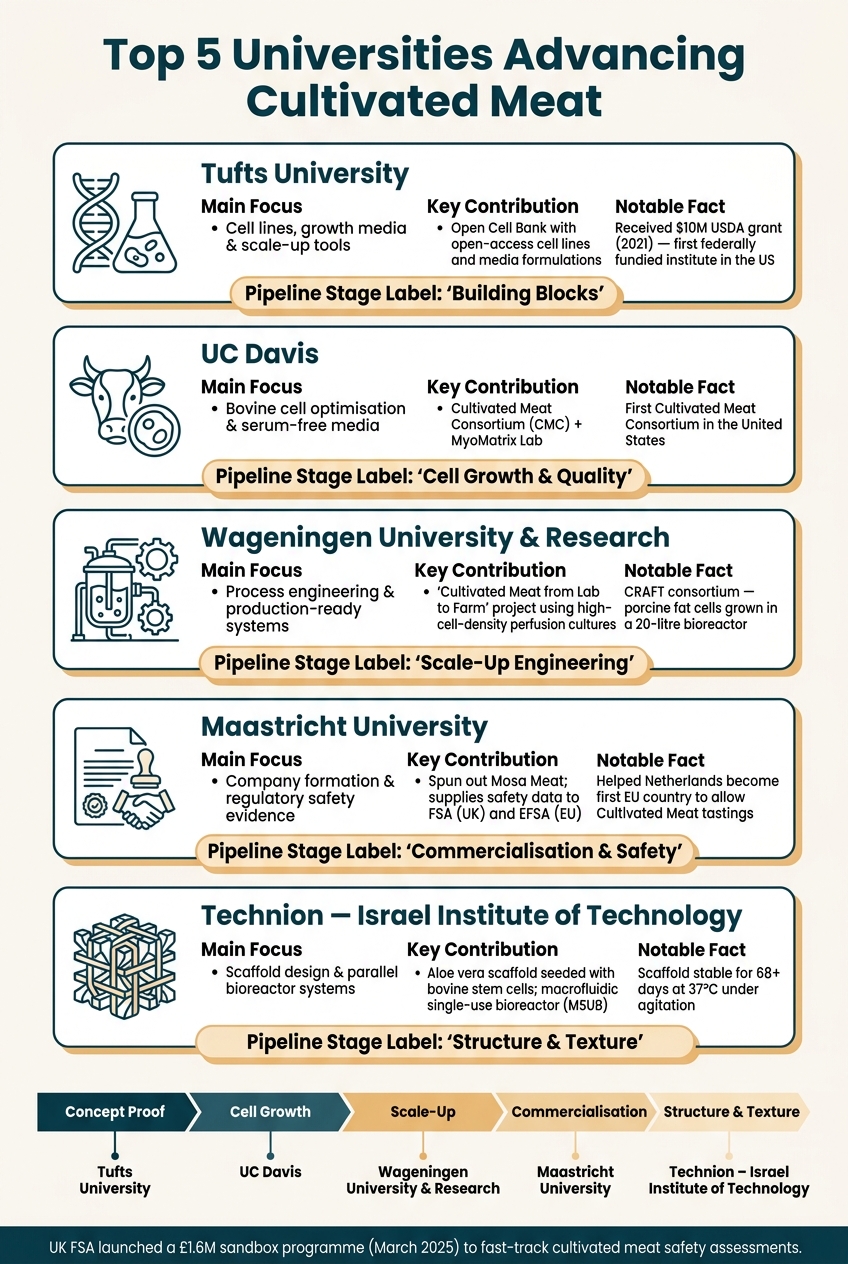
Top 5 Universities Advancing Cultivated Meat: At a Glance
Lab meat: a love story | Dr. Natalie Rubio | TEDxTufts
Quick Comparison
| University | Main focus | What it adds to the field |
|---|---|---|
| Tufts University | Cell lines, media, scale-up | Open tools and production support |
| UC Davis | Bovine cells, serum-free media | Better growth and meat quality |
| Wageningen University & Research | Process engineering | Higher-density production methods |
| Maastricht University | Safety data, spin-outs | Link between lab science and market entry |
| Technion | Scaffolds, bioreactors | Structure, fat tissue work, and scale-out systems |
So if you’re trying to understand who is pushing cultivated meat forward, this is the simple view: no single university does it all, but these five cover the main bottlenecks that still stand between the lab and the plate.
What Makes a University a Leader in Cultivated Meat?
The universities that lead in Cultivated Meat tend to share a small set of clear traits. It’s not just about publishing papers. It’s about helping move the field forward in ways that matter. The five universities below stand out because they meet several of these tests.
The clearest sign is a dedicated research centre that can support long-term work. Short projects don’t usually deliver the steady progress this field needs.
Top universities also focus on the main barriers that stand in the way of commercial Cultivated Meat. That means scaling production through bioprocessing and bioreactor engineering, cutting the cost of growth media, improving taste and texture, and building the safety evidence regulators need. The strongest institutions don’t work on just one problem. They tackle several at the same time.
Another strong signal is direct work with regulators. In March 2025, the UK Food Standards Agency launched a £1.6 million two-year sandbox programme to fast-track safety assessments for Cultivated Meat products. Academic hubs - including the Cellular Agriculture Manufacturing Hub, led by the University of Bath - were brought in alongside companies such as Mosa Meat and Roslin Technologies to help generate that evidence. [2] As Professor Robin May of the FSA noted, safety remains central to innovation. That makes regulator engagement a practical sign of leadership, not just an academic interest.
The last marker is the ability to turn research into commercial results - through spin-out companies, industry partnerships, or prototype development. Taken together, these criteria show why the five universities in this list matter. They are strong across cell science, bioprocessing, sensory quality, and safety evidence.
1. Tufts University
Tufts University has been a leading centre for Cultivated Meat research, with strong work in cell culture, bioprocessing and food science. What makes Tufts stand out is its focus on the field's biggest sticking points.
Dedicated Research Infrastructure
Tufts launched the Tufts University Center for Cellular Agriculture (TUCCA) in 2020. Then, in 2021, it received a $10 million USDA grant to set up the National Institute for Cellular Agriculture, the first federally funded institute of its kind in the US.[6]
That base supports Tufts' work on edible scaffolds and scale-up. In plain terms, it gives researchers the space, tools and backing to work on problems that can hold the whole sector back.
Key Scientific Achievements
Researchers at Tufts are working on two of the toughest issues in the space: edible, food-safe scaffolds that give meat structure, and the use of AI to improve cell lines and growth media.
That matters for a simple reason. Edible scaffolds can help give cultivated meat the right form and texture without leaning on non-food materials. If the goal is food, the building blocks need to make sense as food too.
Scale-Up and Commercial Relevance
Tufts is now moving this work closer to practical production. Kaplan argues that Cultivated Meat will need production methods that go beyond pharmaceutical production systems.
In the second half of 2026, Tufts is launching the Future Food & Material Innovation Hub. It will include:
- a startup incubator
- a shared-access R&D core for prototyping and scale-up
- an Open Cell Bank with open-access cell lines and culture media formulations to cut costs in the global supply chain[7][8]
This is the kind of step that links lab work with what companies need on the factory floor.
Consumer and Regulatory Significance
Kaplan has been direct on safety:
"Anybody who is coming out and saying this food is not safe is incorrect. There's no basis for saying that." [5]
Comments like this keep Tufts in the middle of the safety debate, which matters for both regulators and consumers.
2. University of California, Davis
UC Davis focuses on muscle biology, tissue growth, and bovine cell optimisation for Cultivated Meat.
Dedicated Research Infrastructure
The university set up the UC Davis Cultivated Meat Consortium (CMC), the first group of its kind in the United States. It brings together researchers from biotechnology, food science, and engineering. Alongside that, the Integrative Center for Alternative Meat and Protein (ICAMP) works on moving lab work towards large-scale production.
That setup supports the biology behind cultivated beef, not just the theory on paper.
Its MyoMatrix Lab looks at how muscle adapts, with the aim of improving bovine cell growth and meat quality.
Key Scientific Achievements
UC Davis has put a lot of attention on bovine cell research and serum-free media, which removes animal-derived inputs from cell culture. The team also draws on findings from muscle-disease research to understand how muscle tissue forms.
That link matters. If you can understand how muscle develops and behaves, you have a better shot at growing meat that looks, feels, and eats more like the thing people already know.
Scale-Up and Commercial Relevance
The aim is to make bovine Cultivated Meat use fewer resources by improving cell growth and scaling serum-free media. In plain terms, the work is about making production more workable without losing sight of product quality.
And that’s a big deal, because stronger cell growth and better media don’t just help with manufacturing. They also shape the final eating experience.
Consumer Significance
By focusing on meat quality, UC Davis is taking on one of the sector’s hardest problems: matching the taste and texture of conventional meat.
That has a direct link to public trust as Cultivated Meat gets closer to the market. People may be open to the idea, but the product still has to deliver on the plate.
3. Wageningen University & Research
Wageningen University & Research (WUR) is a major Dutch Cultivated Meat research hub with close ties across the sector. What stands out here is its focus on turning that network into hands-on scale-up work.
Dedicated Research Infrastructure
WUR leads the "Cultivated Meat from Lab to Farm" project, which helps move the field from lab work towards production-ready systems. [9]
Key Scientific Achievements
WUR uses process intensification, including high-cell-density perfusion cultures, to increase cell density for food production. [4] In plain terms, it is working on the kind of engineering work that helps Cultivated Meat move beyond small-scale lab settings and closer to manufacturing.
sbb-itb-c323ed3
4. Maastricht University
Where Wageningen leans more towards process engineering, Maastricht stands out for company building and safety evidence. Maastricht University has helped move Cultivated Meat from early-stage lab work into company formation and regulatory testing.
Key Scientific Achievements and Commercial Relevance
This research directly led to the launch of Mosa Meat. The company has focused on scaling production with non-GM, serum-free growth media, which matters for approval in the EU and UK. Maastricht's current work looks at the gap between laboratory cultivation and industrial-scale production [4]. The aim is to move closer to automated, end-to-end production platforms that existing meat processors could use.
Consumer and Regulatory Significance
Maastricht's role goes beyond commercial spin-outs. The university also helps produce the safety data that regulators need. It is a central hub for the Dutch Cultivated Meat initiative, supplying safety data for the European Food Safety Authority and the UK Food Standards Agency [1].
Its academic work also helped back the Netherlands' position as the first EU country to allow controlled tastings of Cultivated Meat. At the same time, knowledge transfer between Maastricht and UK institutions is growing, including with the Royal Agricultural University (RAU), as both sides look at how Cultivated Meat may fit into the future of farming [1].
5. Technion – Israel Institute of Technology
Technion brings a materials and scale-up angle to the field. While some earlier universities lean more on biology and safety, Technion puts more attention on scaffold design and production systems. Its Sustainable Protein Research Center (SPRC) focuses on Cultivated Meat and brings together tissue engineering, biotechnology and food science. The centre also has cell culture facilities for isolating and refining animal cell lines.
Key Scientific Achievements
One of Technion’s best-known projects uses Aloe vera parenchyma, a byproduct from the cosmetics and beverage industries, as a porous scaffold for Cultivated Meat [10]. The idea is simple, but smart: take a low-cost plant material and turn it into a structure that cells can grow on.
In this work, researchers seeded bovine mesenchymal stem cells (bMSCs) onto the scaffolds [10]. They then added oleic acid to the culture media to push the cells to build up lipid droplets, forming fat-like tissue that can improve flavour and texture in Cultivated Meat products [10].
The scaffold supported:
- cell adhesion
- cell growth
- extracellular matrix formation
It also stayed stable for at least 68 days under agitation at 37°C [10]. That matters because stability under these conditions is a big part of whether a scaffold can work in production, not just in the lab.
Scale-Up and Commercial Relevance
Technion pairs that materials work with a production setup aimed at cutting scale-up costs. Its research uses a macrofluidic single-use bioreactor (MSUB), which supports scale-out production by running multiple smaller reactors in parallel [10].
Instead of relying only on one very large bioreactor, this setup spreads production across smaller units. In practice, that can reduce capital expenditure compared with standard large-scale bioreactors [10]. For companies trying to move from pilot work to commercial output, that difference can be a big deal.
Consumer and Regulatory Significance
Aloe vera is already FDA-approved for human consumption and is a familiar food ingredient [10]. That gives this approach a practical edge. It may help with both regulatory approval and consumer acceptance, since the scaffold material is not new or strange to most people [10].
How These Five Universities Cover Different Parts of the Field
These universities each handle a different part of the Cultivated Meat pipeline. Put them side by side, and the split becomes clear: concept, cell growth, scale-up, system fit, and structure. In plain terms, they cover the route from proof of concept to getting a product ready for market.
Maastricht University showed that the concept can work. Tufts University works on the core tools needed for scale, including open-access cell lines, growth media, and cell mass grown in bioreactors. UC Davis looks at scale-up and meat quality. Wageningen University & Research connects process engineering with food-system testing. Its CRAFT consortium work, including porcine fat cells grown in a 20-litre bioreactor for hybrid meatballs, is a good example of that applied focus [11].
Technion works on structure. Through scaffolds and bioprinting, its researchers are tackling a key part of the puzzle: how to build Cultivated Meat that moves closer to structured cuts, not just minced products [10].
The table below makes those roles much easier to scan.
Top 5 Universities at a Glance
Here’s a quick snapshot of the five universities and where each one fits in the cultivated meat pipeline.
| University | Main contribution | Notable project |
|---|---|---|
| Tufts University | Cell lines, growth media, and scale-up tools | Open Cell Bank with open-access cell lines and media formulations |
| UC Davis | Bovine cell optimisation and serum-free media | Cultivated Meat Consortium (CMC) and MyoMatrix Lab |
| Wageningen University & Research | Process engineering and production-ready systems | "Cultivated Meat from Lab to Farm" project using high-cell-density perfusion cultures |
| Maastricht University | Company formation and regulatory safety evidence | Spin-out of Mosa Meat; safety data supplied to the FSA and EFSA |
| Technion | Scaffold design and parallel bioreactor systems | Aloe vera scaffold seeded with bovine stem cells using a macrofluidic single-use bioreactor |
Each university tackles a different part of the puzzle. Tufts University works on the building blocks, such as cell lines and growth media. UC Davis focuses on bovine cell optimisation and serum-free media. Wageningen University & Research pushes process engineering closer to production. Maastricht University links academic research with company building and safety submissions. And Technion puts the spotlight on scaffold design and bioreactor set-ups.
The next section explains why this research matters for UK consumers.
Why This Research Matters for UK Consumers
These universities are working on the parts of Cultivated Meat that matter most to UK shoppers: safety, taste and price.
The big questions are pretty simple. Is it safe? Does it taste right? And can it get down to supermarket-level prices? Each university on this list is working on at least one of those sticking points. Put together, their work is helping clear the gap between lab-based progress and products people in the UK can actually buy.
One of the biggest cost drivers is growth media - the nutrient mix that feeds cells during production. Work on animal-free, food-grade growth factors is one of the main ways to cut that cost and help production move to a larger scale.[3]
Price isn’t the only hurdle. Taste and texture matter just as much. If Cultivated Meat is going to work in UK restaurants and supermarkets, it has to deliver the flavour and mouthfeel people expect. Consumer uptake depends on safety, nutrition, affordability and a taste that feels familiar. That same push for better prices and better eating quality is now shaping research priorities across the UK as well.
The University of Leeds launched NAPIC to help bring Cultivated Meat closer to market, which shows the UK’s growing investment in turning these products into a commercial option.[3]
This is the research that will shape how soon Cultivated Meat moves from the lab to UK plates.
Conclusion
Taken together, these five universities show how Cultivated Meat research is moving forward on several fronts at the same time. Tufts, UC Davis, Wageningen, Maastricht, and Technion each work on a different part of the same puzzle, from cell biology and scaffolding to cost reduction and commercial availability.
That matters because science, safety, and scale-up need to progress side by side. In the UK, academic research is already helping support the regulatory safety work that will shape when and how Cultivated Meat reaches consumers.
This blend of deep research and practical application is what brings Cultivated Meat closer to UK consumers.
FAQs
Why were these five universities chosen?
These universities were selected for their deep focus, strong facilities and cross-field work in Cultivated Meat research.
They offer tools and spaces such as bioreactors and shared laboratories to tackle key issues like serum-free growth media, cell lines and edible scaffolds. At the same time, they help train skilled people, support innovation networks and make sure the field develops in a way that can last and aligns with consumer expectations.
Which university is closest to commercial scale?
No university is operating at commercial scale yet. Right now, most universities are focused on the early research needed to help that happen.
UCL is helping close the gap between academic work and commercialisation through projects that standardise cultivation processes and scale production. The University of Bath is also helping move things forward through multidisciplinary hubs that connect lab research with industrial manufacturing.
How does this research affect UK approval?
Research at these institutions helps UK approval by supplying the scientific evidence and public input needed for safety checks and policy decisions.
Programmes such as CARMA and NAPIC are working with regulators, including the FSA, to help shape strong frameworks. CARMA also runs citizen forums that feed into the FSA’s 2025–2027 regulatory sandbox for the safe introduction of Cultivated Meat in the UK market.


